Share Blog Article Via
<<< EMBIT NEWSLETTER >>>
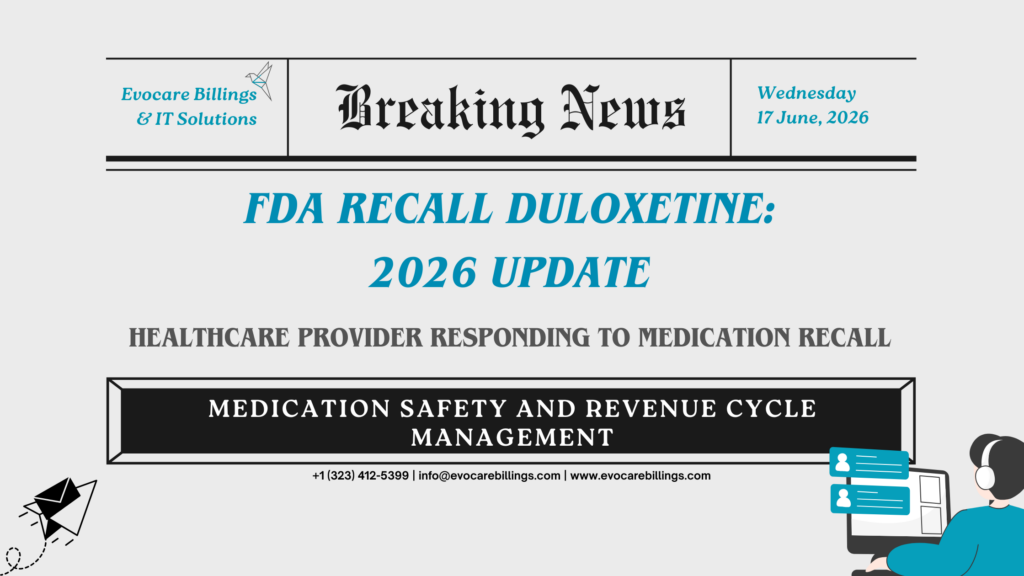
FDA Recalls Duloxetine Capsules Over Nitrosamine Impurity
The healthcare industry is once again reminded of the importance of medication safety following the recent voluntary recall of specific lots of Duloxetine Delayed-Release Capsules. The recall was initiated after testing identified N-nitroso-duloxetine, a nitrosamine impurity, at levels exceeding the U.S. Food and Drug Administration’s (FDA) recommended limits. The FDA classified the action as a Class II Recall, indicating that while the probability of serious health consequences is low, the issue still requires prompt attention from healthcare providers, pharmacies, and patients.
For physician practices, behavioral health clinics, hospitals, and revenue cycle management teams, medication recalls extend beyond patient safety and they can also influence documentation, patient communication, pharmacy coordination, and reimbursement workflows.
This article explains what happened, why it matters, and how healthcare organizations can respond effectively while maintaining compliance and operational efficiency.
>>What Is Duloxetine?
Duloxetine is a prescription medication belonging to the Serotonin-Norepinephrine Reuptake Inhibitor (SNRI) class of antidepressants.
It is commonly prescribed for:
- • Major Depressive Disorder (MDD)
- • Generalized Anxiety Disorder (GAD)
- • Fibromyalgia
- • Diabetic Peripheral Neuropathy
- • Chronic Musculoskeletal Pain
Millions of patients across the United States rely on duloxetine for long-term management of mental health conditions and chronic pain.
>>Why Was Duloxetine Recalled?
According to the FDA, the recalled medication contained elevated levels of N-nitroso-duloxetine, a member of the nitrosamine family.
Nitrosamines are chemical compounds that may develop during manufacturing, packaging, storage, or through interactions between ingredients. Several nitrosamines are classified as probable human carcinogens when exposure occurs at levels above acceptable safety thresholds over long periods. The FDA notes that exposure at or below the acceptable daily intake is not expected to significantly increase cancer risk.
The recall affects selected lots distributed in the United States by Breckenridge Pharmaceutical that were manufactured by Towa Pharmaceutical.
>>Understanding the FDA’s Class II Recall
A Class II recall does not indicate an immediate life-threatening situation.
Instead, it means:
- • Temporary or medically reversible adverse health effects are possible.
- • The likelihood of serious adverse consequences is considered remote.
- • Healthcare professionals should review affected inventory and follow FDA guidance.
- • Patients should contact their healthcare provider or pharmacist rather than discontinue treatment on their own.
Abruptly stopping antidepressants can lead to withdrawal symptoms and worsening mental health, making clinical guidance essential.
>>How Medication Recalls Affect Healthcare Practices
Medication recalls impact far more than pharmacies.
Healthcare organizations often experience increased administrative work, including:
¤Increased Patient Communication
Patients frequently contact their providers seeking reassurance or replacement prescriptions.
¤Additional Clinical Documentation
Providers may need to document medication changes, patient counseling, and updated treatment plans.
¤Prior Authorization Requirements
Switching medications may trigger new insurance authorization requests.
¤Prescription Updates
Alternative medications or replacement prescriptions may need to be transmitted electronically.
¤Insurance Coordination
Coverage differences between medications can require additional payer communication.
Each of these steps increases the administrative workload and places additional pressure on both clinical and billing staff.
>>Revenue Cycle Management Considerations
Although medication recalls are primarily clinical events, they also have financial implications for healthcare organizations.
Practices should monitor:
¤Documentation Accuracy
Every medication adjustment should be clearly documented within the patient’s medical record to support accurate coding and future claim submissions.
¤Charge Capture
Medication-related follow-up visits, counseling, and care coordination services may represent billable encounters when appropriately documented and coded.
¤Claims Processing
Treatment changes can influence diagnosis coding, medication management services, and payer documentation requirements.
¤Audit Readiness
Maintaining complete documentation protects practices during payer audits and regulatory reviews.
A strong Revenue Cycle Management process helps minimize disruptions while ensuring accurate reimbursement.
>>Best Practices for Healthcare Providers
Healthcare organizations should establish a structured response whenever medication recalls occur.
Recommended actions include:
¤Review Inventory
Confirm whether any affected medication lots remain in clinical inventory.
¤Notify Appropriate Staff
Ensure physicians, nurses, pharmacists, and administrative personnel are aware of the recall.
¤Educate Patients
Provide clear guidance that patients should never discontinue prescribed antidepressants without medical advice.
¤Update Medical Records
Document all medication changes, counseling discussions, and replacement therapies.
¤Coordinate with Pharmacies
Verify medication availability and replacement options.
¤Monitor Insurance Coverage
Confirm payer coverage before prescribing alternative medications.
>>The Growing Importance of Medication Safety
Nitrosamine-related recalls have become an ongoing concern across the pharmaceutical industry.
Over the past several years, multiple medications have been recalled after elevated nitrosamine levels were detected. These events have increased regulatory oversight and prompted manufacturers to strengthen quality control, manufacturing processes, and impurity testing.
Healthcare organizations should remain informed about FDA safety communications to ensure timely patient care and regulatory compliance.
>>How Revenue Cycle Partners Can Help
Medication recalls often generate unexpected administrative burdens.
An experienced Revenue Cycle Management partner can help practices by:
- • Managing documentation workflows
- • Supporting insurance verification
- • Handling prior authorizations
- • Processing claims accurately
- • Monitoring denied claims
- • Reducing Accounts Receivable delays
- • Maintaining payer compliance
- • Improving reimbursement accuracy
At Evocare Billings & IT Solutions LLC, we help healthcare organizations navigate operational challenges while maintaining an efficient and compliant revenue cycle.
Our comprehensive RCM solutions include:
- • Medical Billing & Coding
- • Claims Submission
- • Eligibility Verification
- • Prior Authorization
- • Payment Posting
- • Denial Management
- • Accounts Receivable Follow-up
- • Provider Credentialing
- • Practice Performance Reporting
Whether responding to regulatory updates or managing everyday billing operations, our experienced team enables providers to focus on delivering exceptional patient care.
>>Final Thoughts
The FDA’s duloxetine recall highlights the importance of proactive medication safety, clear patient communication, and accurate clinical documentation. While the FDA considers the overall risk of serious harm to be remote, healthcare organizations should promptly review affected products, communicate with patients, and ensure that treatment decisions are well documented.
For medical practices, maintaining a resilient Revenue Cycle Management process during clinical disruptions helps reduce administrative strain, minimize claim delays, and protect financial performance.
Healthcare organizations that combine strong clinical workflows with effective billing operations are better positioned to deliver high-quality patient care while maintaining financial stability.
Ξ(FAQ)
∴ Is duloxetine being completely discontinued?
No. The recall applies only to specific affected lots. Duloxetine remains an FDA-approved medication.
∴ Should patients stop taking recalled duloxetine immediately?
No. Patients should first contact their healthcare provider or pharmacist. Abruptly stopping antidepressants can be harmful.
∴ What caused the recall?
Testing detected N-nitroso-duloxetine, a nitrosamine impurity, above the FDA’s recommended interim limit.
∴ Does a medication recall affect insurance claims?
Potentially. Medication changes may require updated documentation, prior authorization, or revised treatment plans that can affect billing workflows.
∴ How can Evocare help healthcare practices?
Evocare provides end-to-end Revenue Cycle Management, medical billing, denial management, credentialing, insurance verification, and compliance support to help practices maintain operational and financial performance.
Contact us today at info@evocarebillings.com or call (323) 412-5399 to explore how we can help your practice grow with smarter, more efficient billing solutions

Newsletter
Stay updated with industry trends, tips, and smart revenue cycle insights.

Case Study
See how real practices transformed revenue cycles and overcame billing challenges.

Let's get in touch
Please fill up the form, one of our AAPC certified medical biller and coder will reach out to you